Monday, December 28, 2015

Temperature and Neodymium Magnets

How Hot is Too Hot?

What is the maximum allowable temperature of a neodymium magnet?  What happens if a magnet goes above this temperature?  How do I read a Demagnetization Curve?  Temperature issues and neodymium magnets can be a complex subject.  In this article, we'll try and simplify some of these concepts, and answer a few common questions.

The Basics

On our Specs page, two key temperatures are listed: the Maximum Operating Temperature, and the Curie Temperature.
Curie Temperature is the temperature at which all magnetization of the magnet is lost.
Maximum Operating Temperature (abbreviated to MaxOpTemp hereafter) is a general number given for each different grade of magnet material.  While not exact, it's a good guideline which applies to many situations.  In between the MaxOpTemp and the Curie Temperature, some percentage of the magnetization is irreversibly lost.
For many situations, this is enough information to work with.  If your eyes glaze over reading some of the technical information below, don't worry.  You can stop right here and be OK for many applications.

Some Definitions:

Magnetic Strength: Throughout this article, magnetic strength is the key measure.  The product of B times H is often used to described the strength of neodymium magnets.  For example, grade N42 magnets have a maximum BH (called BHmax) of 42MGOe.  This number directly relates to Pull Force Case 1, the attractive force from a single magnet stuck to a large steel plate.  You could also express this as magnetic field, measured in Gauss, at some specific location.  We specify Surface Field in Gauss, measured at the surface of the magnet.  Magnetic Strength is not power, or work, and cannot be expressed in terms of power.
Reversible losses: Up to the MaxOpTemp, you will see some loss of magnetic strength at those elevated temperatures.  When you bring the magnet back down to room temperature, it returns to the original strength.  These losses are small, typically within 5 to 10 percent.
Irreversible losses: Above the MaxOpTemp, some magnetization is lost.  When you bring the magnet back down to room temperature, it will be weaker than it was before the heating process.  A magnet that has had irreversible losses could theoretically be re-magnetized to the original strength, or very close to it.  (K&J Magnetics does not offer re-magnetization services for demagnetized magnets.)
Permanent losses: Above temperatures where the magnet material was originally sintered, structural changes will occur to permanently demagnetize a magnet.  No amount of externally applied magnetic field will bring the magnet's strength back.  For neodymium magnets, this temperature is very high, typically above 900°C to 1000°C.

How much strength will I lose at a given temperature?

We have to dig a little deeper to answer this level of magnet-geek question.  Let's start by getting a better estimate for MaxOpTemp.  The MaxOpTemp of a given magnet will depend largely on how it is used, "in circuit."  For a magnet in free space, this means it depends on the shape of the magnet.
Yes, that's right, MaxOpTemp depends on the shape of the magnet.  That's a hard concept to swallow, especially when we're used to thinking of operating temperatures as a material property.  Water boils at 100°C whether it's in a tall glass or a wide bowl.  Magnets, however, are not that simple.
The measure of this shape is called the Permeance Coefficient.  It's also sometimes called BH, the operating slope, or the load line.  You can find the Permeance Coefficient for any size/shape neodymium magnet in free space using our Magnet Calculator.  Generally, it is a larger number for tall, narrow magnets, and a smaller number for thin, wide magnets.

Demagnetization Curves/ BH Curves

You can find graphs of BH Curves for most of our common magnet grades here.  Let's define a few of the interesting features of these curves shown in Figure 1.
Figure 1: BH Curves for N42 magnets
Normal Curve: This curve describes the magnet's performance.  Use the curve for the desired operating temperature.  It's the curve most referred to for design purposes.  The linear portion of this curve has a slope that's sometimes called the Recoil Permeability.  For neodymium magnets, this slope is usually 1.05.
The Knee: The part of the Normal Curve where it bends down, becoming a vertical line.
Intrinsic Curve: The intrinsic curve can be derived from the normal curve, and vice versa.  Don't worry about this curve for now.
Load Line: A line from the origin, with a slope equal to the Permeance Coefficient of the magnet in circuit.  It's also called the Operating Line.  Draw this line from zero to the Permeance Coefficient of your magnet shown around the edges of the graph.
Operating point: The intersection of the Load Line and the Normal Curve describes the single operating point of a magnet.


Example # 1 - A D82 in Free Space

Let's walk through a few examples to illustrate how to use these charts, and what it all means.  Example # 1 is our 1/2" diameter x 1/8" thick, Grade N42, D82 magnet in free space.  Refer to the the N42 BH Curve for this magnet.  From the Magnet Calculator, I find that Pc, the Permeance Coefficient, is 0.61.  Draw a line from the origin (0,0), out to Pc = 0.61.  This is your load line.
With the load line shown in green below, you can find the operating point of this magnet.  At 20°C, it's at the blue dot, where the load line intersects the normal curve.  At 80°C, the operating point would be right at the knee of the normal curve.  Therefore, 80°C is the MaxOpTemp.

Figure 2: D82 Magnet at 20C


Above 80°C, the magnet begins to irreversibly demagnetize.  Let's consider a magnet that's gone up to 100°C -- dropped in boiling water.  The operating point shown as a blue dot below is at the intersection of the green load line, and the 100°C normal curve.  It is below the knee of the normal curve.  The operating point has dropped down by a distance shown as "B" in the Figure 3 below.
When you cool this magnet back to room temperature, it won't climb back up the knee.  It will drop by an amount shown graphically in purple, as "A".  The red dot represents the new operating point once the magnet cools back to 20°C.  The new operating point is dropped from the 20°C normal curve by the amount lost when the magnet went up to 100°C.;
Figure 3: D82 at 100C
What does this new operating point mean?  How much pull strength will be lost?  Consider that pull strength is closely related to the product of B times H.  Use the absolute value, and ignore the negative values of H.  Graphically estimating B * H from the blue dot in Figure 2, it is approximately 38.6 MGOe.  Doing the same for the red dot in Figure 3, I find about 26.3 MGOe.  So, the strength will have dropped to roughly 26.3 / 38.6 or to about 60% of the original strength.

Example # 2 - A D44 in Free Space

Let's consider an example with a higher value for the Permeance Coefficient.  Any cylinder whose diameter is equal to it's height, like a 1/4" D44, will have a Pc = 3.46.  Again, you can find this value using our Magnet Calculator.
Below, the load line is again shown in green.  At 20°C, the operating point is shown in blue.  At 140°C, the operating point is shown in red.  It is interesting that we're using a regular N42 grade magnet, but not showing any losses due to temperature until it's over 140°C.
Figure 4: D44 BH Curves

Example # 3 - A D61 in Free Space

For our final example, let's consider a very thin magnet.  A D61 is a 3/8" diameter x 1/16" tall magnet.  This size is also available in the higher temperature grade N42SH, as a D61SH.  The Calculator indicates that the Pc value for this magnet is 0.38 in free space.  Again, the load line is shown below in green.
The operating point at 60°C is shown in blue.  At this temperature, we're still on the linear portion of the normal curve, so no loss of strength is expected.  At 80°C, the operating point is shown in red.  This is below the knee of the curve, so some amount of irreversible loss of strength is expected.  This result illustrates a handy rule of thumb: The MaxOpTemp may be lower for very thin magnets.
Figure 5: D61 BH Curves


If you need better temperature performance in this shape, consider the D61SH.  On our Specs page, N42SH magnets are listed as having a MaxOpTemp of  302°F (150°C).  Checking the N42SH BH Curves below, we find that the magnet performs without any losses at 80°C or even 110°C.  At 140°C, at the operating point shown at the red dot, we just start to see the first loss of strength.  The D61SH is clearly a better performer at high temperatures than the D61.
Figure 6: D61SH BH Curves


Final Notes

All these examples looked at disc/cylinder magnets.  Everything above is also true for other shapes.  The Magnet Calculator provides Pc values for Blocks and Rings too.
In all these examples, it was assumed that the Permeance Coefficient for a single magnet in free space was applicable.  In your application, this may not be true.  If the magnet is stuck to a big steel plate, it could be slightly less.  If it is stuck to another magnet, can be substantially more.  It does depend on your specific application.  All this theory is a great guideline, but be sure to test in your own situation.
How cold can neodymium magnets get?  Generally, the colder they get, the stronger they are.  We have yet to find the low temperature that hurts them.  Temperatures as low as -40°C to -60°C don't pose a problem.
What about temperature cycling?  This is a popular question.  As long as you're staying below the Maximum Operating Temperature, it doesn't matter how many times you cycle the magnet's temp.  No irreversible losses occur until you get above the MaxOpTemp.  Even then, if you lose some strength because the magnet strayed above that temperature, you wouldn't incur any successive losses by repeatedly going up to that same temperature.
What about N52?  If you compare the N52 curves to the more common N42, you'll see that there are trade-offs when you choose the most powerful magnet grade available.  In some cases, especially with thinner magnets, N52 magnets can have lower MaxOpTemps than N42.  Be sure to consider this in your selection process.

UPDATE: Low Temperature Information Added!

What about neodymium magnet performance at very low temperatures?  How about cyrogenic temperatures?
The graph at right shows measurement data of one magnet's Surface Field at very low temperatures.  If you start at room temperature (20°C) and get colder, the strength of the magnet increases by a small amount.  Below about -125°C, the strength then drops much more quickly.
Still, even at temperatures near absolute zero, there is still a good deal of magnetic strength left.  Even at the boiling point of liquid nitrogen, -196°C, there's still roughly 87% of the field strength you would find at room temperature.
Neodymium magnets are certainly usable at these low temperatures, but the loss in strength below -150°C should be planned for.  In most cases, the strength should return to normal once the magnet is brought back up to room temperature.

Why does this happen?  Neodymium magnets have a preferred magnetization direction. At these very cold temperatures, something happens in the structure of the molecules in the magnets, which temporarily changes the preferred direction by as much as a 30 degree angle.  This change is what reduces the strength.  When heated back up, the orientation returns to the original direction.

Sunday, December 27, 2015

Magnets Are Used Everywhere In Our Life At Home Or Office

Magnets Are Everywhere

Wow, you guys at K&J offer a lot of magnets.  What are they all used for?
Magnetic Thumbtacks on a fridge.
Powerful neodymium magnets are used for much more than fancy fridge magnets.  In fact, magnets have permeated our lives so much recently, in ways that aren’t always obvious, that we are surrounded by magnets more than ever.
In this article, we’ll take a look at some of the amazing and unexpected ways that magnets have transformed modern life.  Rather than look at where magnets are used everywhere in the world, we’ll limit the discussion to magnets found in a typical home.
There are a lot of magnets in my house.
Before the middle of the 20th century, let's say about 1950, most people had only a few magnets in their homes. Today, that number is more likely in the hundreds.  That’s true even for readers like you who don’t work here at K&J Magnetics!  Where are these magnets hidden in your home?  What are all these magnets for?

Fridge Magnets

White HOOK-WHT hooks holding up a few aprons on a steel door.
Let’s check off this obvious category from the list first.  There are a number of fridge magnets we sell, like Magnetic Thumbtacks or other neodymium magnets used for fridge magnets.  You might also have a flexible magnet or two on your fridge, probably with an advertisement printed on it.
Let’s make this category even larger.  Let’s define it as anything where magnets are sticking to something in your house to hold stuff up.  Maybe you use a Magnetic Hook to hold up a decoration on your steel front door.  Maybe you use hooks to hold up aprons.

Magnetic Cabinet Latches

Magnetic cabinet catch.
The doors on cabinets or other furniture doors often have magnetic catches or closures on them.  Usually, these are made with an inexpensive ceramic magnet sandwiched between two steel plates, which attract to and come into contact with a steel “strike plate” on the door.  While we're starting to see some closures made with powerful neodymium magnets, most are still using inexpensive ceramic magnets.

Audio Speakers

Audio Speakers
Most speakers are made with some kind of permanent magnet that interacts with a coil of wire (an electromagnet, really).  The audio signal flows through the wire, and moves the speaker.  The speaker moves air, making sound.  We demonstrated the basics of how a speaker works back in our Audio Speakers article.
How many speakers are in a home?  Count all the speakers: don’t forget radios, stereo systems, televisions, etc.  Count cell phone speakers, but not microphones.  (Most cell phone microphones are condenser/electret microphones, and do not contain a permanent magnet.)  Don’t forget the speakers in your car.  Count each ear-bud in any music playing device you might have.
Which ones use neodymium magnets?  Usually it's the ones where small size counts.  While the huge speaker of a subwoofer might utilize a ceramic magnet, the tiny earbuds you use with your smartphone or mp3 player are likely to use neodymium magnets.

Electric motors

An electric motor from a DVD drive
This is a huge category.  If you can think of something electronic that moves, it probably has magnets in it (not 100%, though).  The automatic windows in cars?  Each window has its own motor.  The tray on your DVD player?  Motors.
The popularity of magnetic tape recordings with VHS VCRs has declined, but our transition to DVDs and BluRay optical discs doesn’t mean we got rid of magnets.  The typical DVD player has quite a few of them inside, including a motor to spin the disc, a motor to open and close the disc tray, a motor to roughly position the read head/laser, and even a fine electromagnetic control of the read head.  That's at least four magnets right there in one DVD player!
If your computer has a disc reader/writer in it, figure that has another 4+ magnets.
What else in the home moves with electric motors?  The ice dispenser in a fridge.  The garbage disposal.  A trash compactor.  The spinning tray in a microwave (in addition to the big magnet used in making the microwaves).  Electric fans, the blower in a hair dryer, fans and blowers in a refrigerator.  A garage door opener.  The pump in an aquarium.  The rotating parts of washers and dryers.  Blenders and mixers.  The list goes on and on, and most of these motors have permanent magnets in them.
Note: Not every electric motor has a permanent magnet in it.  Some kinds of motors, like the electric induction motor, uses two coils of wire instead of a coil and a permanent magnet.  The motor in my ShopVac is an induction motor, and does not use permanent magnets.
In a car, all sorts of things are controlled by motors: power windows, various pumps, windshield wipers and more.

More Electronic Devices

Laptops have speakers, magnetic sensors, hard drives...
A computer’s hard drive has a number of magnets in it as well, in addition to being a magnetic storage device.  (Let’s keep this number reasonable, and not consider every one and zero stored on it as an individual magnet, even if it is technically true.)  Still, the hard drive has magnets for the motor to spin the disc and another magnet to control the position of the read heads.
Have a DVR?  That’s got a hard drive in it too.
Laptop computers and flip phones use a magnet to sense when it is open or closed.  See Reed Switches and Hall Effect Sensors for more info on how they work.
What else? Lawnmower engine ignition sensor. Car crankshaft sensor.  Bicycle cyclometer.
In the garage, a pick-up tool that is sometimes handy for picking up dropped screws and bolts.  A D6C and a D8APC-BLK cylinder in the toolbox for magnetizing screwdrivers, locating studs, etc.
What have we missed?  If you can think of any more magnets commonly found at home, email us and we'll add it here!

The Internet

(How do you take a picture of the Internet?)
I know we mentioned hard drives already, but stop for a moment and imagine a world without hard drives.  There would not be an Internet as we know it. There would be no cloud, no Google Mail, no huge sea of information for a smartphone to access.  The information explosion of PCs, smartphones and online storage of information is all ultimately built on little magnetic bits stored on hard drives.

Other magnetic stuff, which might not include permanent magnets

Since we’re in the business of selling magnets, this article focused on permanent magnets and their uses.  This ignores the much larger world of magnetic materials, used in everything from transformers to hard drive discs.  Even if they aren’t permanent magnets, there’s an even larger number of devices that power our technological lives based on magnetism.  Maybe that’s a list for another day…


Where are magnets used?

Motors & Generators: 34.4%
HDD, CD & DVD: 13.6%
Transportation: 10.9%
Energy Production/Storage: 7.2%
Tranducers: 6.2%
Drives, Clutches, Braking: 5.6%
Relays, Sensors, Switches: 4.1%
Appliances: 3.4%
Wave Guides: 2.6%
Other: 12%
What applications use all the magnets?
We found some varying statistics, depending on what source you read.  Of course, we don't know where all the magnets we sell actually get used, so consider these numbers as approximate.  The numbers in the colored chart are a fair estimate.  It shows where newly produced magnets end up getting used.

Looking in your house for only the places magnets are used listed in this article, from motors to speakers, how many magnets can you count in your home?  I started losing track somewhere above 150...


Friday, December 25, 2015

Neodymium Magnet Physical Properties

Neodymium Magnet Physical Properties

Magnet Summary Table - Click this link for the pull force and surface field of each of our stock magnets listed in table format

Magnetic Characteristics

Material TypeResidual Flux Density
(Br)
Coercive Force
(Hc)
Intrinsic Coercive Force (Hci)Max.Energy Product
(BH)max
N3511.7-12.1 KGs>11.0 KOe>12 KOe33-35 MGOe
N3812.2-12.6 KGs>11.0 KOe>12 KOe36-38 MGOe
N4012.6-12.9 KGs>11.0 KOe>12 KOe38-40 MGOe
N4213.0-13.2 KGs>11.0 KOe>12 KOe40-42 MGOe
N4513.3-13.7 KGs>11.0 KOe>12 KOe43-45 MGOe
N4813.8-14.2 KGs>11.0 KOe>12 KOe45-48 MGOe
N5014.1-14.5 KGs>11.0 KOe>11 KOe48-50 MGOe
N5214.5-14.8 KGs>11.2 KOe>11 KOe49.5-52 MGOe
N35M11.7-12.1 KGs>11.4 KOe>14 KOe33-35 MGOe
N38M12.2-12.6 KGs>11.4 KOe>14 KOe36-38 MGOe
N40M12.6-12.9 KGs>11.4 KOe>14 KOe38-40 MGOe
N42M13.0-13.3 KGs>11.4 KOe>14 KOe40-42 MGOe
N45M13.3-13.7 KGs>11.4 KOe>14 KOe42-45 MGOe
N48M13.6-14.2 KGs>11.4 KOe>14 KOe45-48 MGOe
N50M14.1-14.5 KGs>11.4 KOe>14 KOe48-50 MGOe
N33H11.4-11.7 KGs>10.3 KOe>17 KOe31-33 MGOe
N35H11.7-12.1 KGs>10.8 KOe>17 KOe33-35 MGOe
N38H12.2-12.6 KGs>11.4 KOe>17 KOe36-38 MGOe
N40H12.6-12.9 KGs>11.4 KOe>17 KOe38-40 MGOe
N42H13.0-13.3 KGs>11.4 KOe>17 KOe40-42 MGOe
N45H13.3-13.7 KGs>11.4 KOe>17 KOe42-45 MGOe
N48H13.6-14.2 KGs>11.4 KOe>16 KOe45-48 MGOe
N30SH10.8-11.2 KGs>10.1 KOe>20 KOe28-30 MGOe
N33SH11.4-11.7 KGs>10.3 KOe>20 KOe31-33 MGOe
N35SH11.7-12.1 KGs>10.8 KOe>20 KOe33-35 MGOe
N38SH12.2-12.6 KGs>11.4 KOe>20 KOe36-38 MGOe
N40SH12.6-12.9 KGs>11.4 KOe>20 KOe38-40 MGOe
N42SH13.0-13.3 KGs>11.4 KOe>20 KOe40-42 MGOe
N45SH13.3-13.7 KGs>11.4 KOe>19 KOe43-45 MGOe
N28UH10.4-10.8 KGs>9.8 KOe>25 KOe26-28 MGOe
N30UH10.8-11.2 KGs>10.1 KOe>25 KOe28-30 MGOe
N33UH11.4-11.7 KGs>10.3 KOe>25 KOe31-33 MGOe
N35UH11.7-12.1 KGs>10.8 KOe>25 KOe33-35 MGOe
N38UH12.2-12.6 KGs>11.4 KOe>25 KOe36-38 MGOe
N40UH12.6-12.9 KGs>11.4 KOe>25 KOe38-40 MGOe
N30EH10.8-11.2 KGs>10.1 KOe>30 KOe28-30 MGOe
N33EH11.4-11.7 KGs>10.3 KOe>30 KOe31-33 MGOe
N35EH11.7-12.1 KGs>10.8 KOe>30 KOe33-35 MGOe
N38EH12.2-12.6 KGs>10.8 KOe>30 KOe36-38 MGOe

Thermal Characteristics

Neodymium Material TypeMaximum Operating TempCurie Temp
N176°F (80°C)590°F (310°C)
NM212°F (100°C)644°F (340°C)
NH248°F (120°C)644°F (340°C)
NSH302°F (150°C)644°F (340°C)
NUH356°F (180°C)662°F (350°C)
NEH392°F (200°C)662°F (350°C)
The Thermal Characteristics listed above are values commonly associated with each magnet's grade or material.  Actual performance in your application may vary with other factors, including the shape of the magnet, the Permeance Coefficient or load line, and how it is used in a circuit.  See our in-depth article on Temperature and Neodymium Magnets for more details.

Physical and Mechanical Characteristics

Density
7.4-7.5 g/cm3
Compression Strength
950 MPa (137,800 psi)
Tensile Strength
80 MPa (11,600 psi)
Vickers Hardness (Hv)
560-600
Young's Modulus
160 GPa (23,200 psi)
Recoil Permeability
1.05 μrec
Electrical Resistance (R)
160 μ-ohm-cm
Heat Capacity350-500 J/(kg.°C)
Thermal Expansion Coefficient (0 to 100°C)
parallel to magnetization direction
5.2 x 10⁻⁶ /°C
Thermal Expansion Coefficient (0 to 100°C)
perpendicular to magnetization direction
-0.8 x 10⁻⁶ /°C

Plating Characteristics

Plating TypeOverall ThicknessSalt Spray TestPressure Cooker Test
NiCuNi (Nickel Copper Nickel)15-21 μm24 hours48 hours
NiCu + Black Nickel15-21 μm24 hours48 hours
NiCuNi + Epoxy20-28 μm48 hours72 hours
NiCuNi + Gold16-23 μm36 hours72 hours
NiCuNi + Silver16-23 μm24 hours48 hours
Zinc7-15 μm12 hours24 hours
Each individual layer of Nickel and Copper are 5-7 μm thick. The Gold and Silver plating layers are 1-2 μm thick.
Test results shown to allow comparison between plating options. Performance in your application under your specific test conditions may vary. Salt Spray testing conducted with a 5% NaCl solution, at 35°C. Pressure Cooker Test (PCT) conducted at 2 atm, 120°C at 100% RH.

Measurement Systems

Unitcgs SystemSI SystemEnglish System
Length (L)centimeter (cm)meter (m)inch (in)
Flux (ø)MaxwellWeber (Wb)Maxwell
Flux Density (B)Gauss (G)Tesla (T)lines/in2
Magnetizing Force (H)Oersted (Oe)Ampere turns/m (At/m)Ampere turns/in (At/in)
Magnetomotive Force (mmf or F)Gilbert (Gb)Ampere turn (At)Ampere turn (At)

Conversion Between Systems

cgs System to SI system
1 Oe = 79.62 At/m
10,000 G = 1 T
1 Gb = 0.79577 At
1 Maxwell = 1 Line = 10-8 Wb
1 G = 0.155 lines/in2

What are Magnet Grades? Magnet Grades

Magnet Grades

Neodymium magnets come in different grades such as N42, N52 or N42SH.  What do these numbers mean?  How does the grade relate to the strength of a magnet?  Does a magnet have a Gauss number?

What are Magnet Grades?

A magnet grade is a good measure of the strength of a magnet.  In general, higher numbers indicate a stronger magnet.
The number comes from an actual material property, the Maximum Energy Product of the magnet material, expressed in MGOe (Mega Gauss Oersteds).  It represents the strongest point on the magnet’s Demagnetization Curve, or BH Curve.
The pull force from a magnet varies with the grade or N number.  Double the N number and you’ll find roughly double the pull force. 

How do you measure the strength of a magnet?

It depends on what is meant by strength.  Two common measures of a magnet’s strength are the pull force and the strength of the magnetic field.

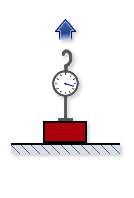
Pull force is how much force you have to pull on a magnet to move it away from something, such as a steel surface or another magnet.  We show this force in pounds on our site, though you could also express it in Newtons, or even kilograms.  The specific way the magnet is tested can have a huge influence on the measured strength.

We show several different measures of strength, as described in our Pull Force FAQ answer.  The number we use most is Pull Force, Case 1.  It is the force required to pull a magnet directly away from a steel surface.  It is a great reference for magnet strength, expressed as a single number.  Even if your application doesn’t pull on the magnet in the same way, this is often a good number to use to compare the strength of different magnets.

Interestingly, the pull force between two magnets that are touching (which we call Case 3 in our online calculators) is equal to Pull Force, Case 1.
The magnetic field strength is a measurement of the magnetic field’s strength and direction at a particular point near the magnet.  It is expressed in Gauss or Tesla (1 Tesla = 10,000 Gauss).  It depends on the size, shape and grade of the magnet, where the measurement is performed, and the presence of any other magnets or ferromagnetic materials nearby.  Our Surface Fields article is a good place to learn more about this.

This is the important number when using magnets to activate a reed switch or Hall effect sensor.

What Grade Should I Choose?

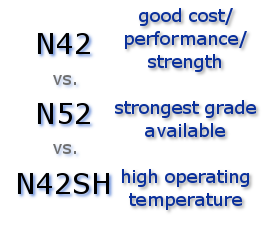
It depends on the application.  If you need the highest strength in the smallest possible package at room temperature, grade N52 is the strongest available.
Many of our magnets are offered in grade N42, which is a great balance between cost, strength and performance at higher operating temperatures.  You can get the same strength as an N52 magnet by using a slightly larger N42 magnet.
If you have slightly elevated temperatures, in the 140°F to 176°F range (60°C -80°C), N42 magnets might actually be stronger than N52.  This is especially true if your magnet shape is very thin.  See our detailed article on Temperature and Neodymium Magnets for more details.
For even higher temperatures, consider some of our High Temp Magnets, offered in the N42SH grade.  For a complete list of available grades, see our Specs page.

How many Gauss is a magnet?

We’re often asked if a magnet “has 10,000 Gauss.”  This is a bit of a strange question, since Gauss is a unit of magnetism that can apply to different measurements or magnet properties.  A magnet doesn't have one specific amount of Gauss in it.  Two common measurements expressed in Gauss are The Residual Flux Density, Br, and the Surface Field.
Residual Flux Density, Br, is the magnetic induction remaining in a saturated magnetic material after the magnetizing field has been removed.  Scroll down to the last section of this article for a more detailed explanation.
This number is a material property which is independent of the magnet shape.  Grade N42 magnets have a Br of 13,200 Gauss, while N52 magnets can be as high as 14,800 Gauss.  See our Specs page for more Br values for various neodymium magnet grades.
The Surface Field is the strength of the magnetic field measured right at the surface of the magnet.  It’s the field strength you might measure if you could squish a magnetometer’s sensor right up against the surface.  This number depends on the magnet material, the shape of the magnet and how it’s used in a magnetic circuit.

How Do Neodymium Magnet Grades Compare to Other Magnet Types?

Magnet TypeMax Energy Product (MGOe)
Neodymium35-52
SmCo 2626
Alnico 5/85.4
Ceramic3.4
Flexible0.6-1.2
Neodymium magnets are by far the strongest type of permanent magnet available.  Magnet advancements are a history of increasing coercivity.  Neodymium magnets are both stronger and less apt to be demagnetized than other magnet types.

Where do these N numbers come from?

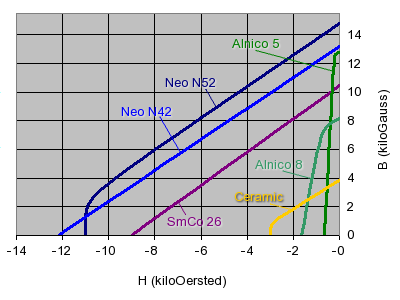
Demagnetization curves for various magnet types at 20C
The performance of a magnet material is defined by that material’shysteresis curve, also known as a Demagnetization Curve or BH Curve.  The Maximum Energy Product is the point on this curve where the B value multiplied by the H value is at its maximum.
At a point on the curve, multiply the "B" value (in kilo Gauss) by the "H" value (in kilo Oersted) to get the Maximum Energy Product (in Mega Gauss Oersted, or MGOe).  For example, grade N42 has a Max Energy Product of 42 MGOe.
Magnets with a bigger Maximum Energy Product will have greater strength.  Specifically, the shape of the BH Curve indicates both how strong a magnet is and how strong of a magnetic field you would need to demagnetize the magnet.

Appendix: What is a BH Curve? (WARNING: Technical Content Follows)

A BH Curve describes the magnetic properties of the magnetic material.  Let’s examine one step by step.

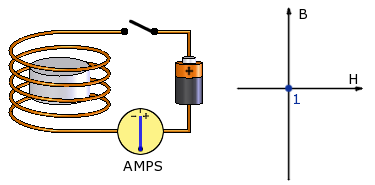
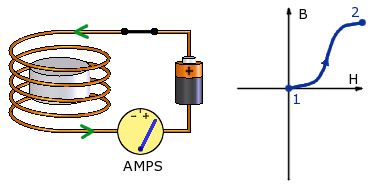
Consider a neodymium magnet sitting inside a magnetizer.  The magnetizer is essentially a coil of wire wrapped around the magnet, through which we will apply a very strong current to create a magnetic field.

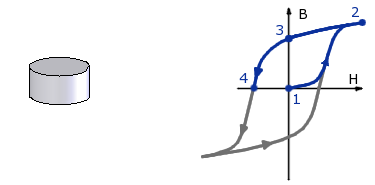
In the graph at right, the horizontal axis shows the strength of the Applied magnetic field (H) – the one we get by running current through the wire.  The vertical axis shows the Induced field (B), which the permanent magnet creates by itself. around the magnet, through which we will apply a very strong current to create a magnetic field.

The magnet we will start with has just been manufactured, but not yet magnetized.  The magnetic field it creates is zero (B).  There is no current running through the wire, so the applied field (H) is also zero.  Let’s represent this point with a dot at the zero location on the graph, point #1.

Now, let’s briefly run a terrifically strong current through the wire, placing the magnet in a uniform magnetic field.  Keep increasing the current, and the applied field increases.  If we measure the magnetic field, we also see an induced magnetic field, made from the magnet.

At point #2, the increases level off.  At point #2, we still have a current running through the wire producing an Applied field, plus an Induced field from the magnet.

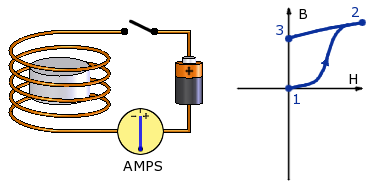
Now, let’s turn the current off.  The Applied field (H) drops to zero, but there remains a magnetic field produced by the magnet, shown as point #3. This point is also called Br, Br max, the Residual Induction or the Residual Flux Density.

In our Glossary, we define Br as, “the magnetic induction remaining in a saturated magnetic material after the magnetizing field has been removed.”  That's at point #3.

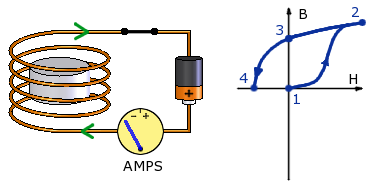
If we apply a current in the opposite direction, the magnetic field created by the current in the coil of wire opposes the field from the magnet -- it is in the opposite direction.

By applying progressively more current in this direction, we can find the shape of the normal curve in the second quadrant (the upper left hand quarter) of the BH Curve graph.  Where the Induced field reaches zero, at point #4, is called the Coercive force, Hc.  This is the magnet's Coercivity: the measure of the magnet’s resistance to demagnetization by an external magnetic field.

The farther left on the graph this point is located, the stronger the magnetic field you need to demagnetize the magnet.  Not only are neodymium magnets strong, but they have the highest coercivity values of all permanent magnet types.

The rest of the graph follows a symmetric form.  The whole shape of this graph is the hysteresis curve, and defines how a particular magnet material behaves. It is a property of the magnet material.

When considering the performance of an already magnetized magnet in an application, we only need to look at the 2nd quadrant (the upper left quarter of the graph) to see how it will behave.

The shape of the curve shows how the magnet works in actual applications.  The actual operating point on the graph depends on the shape of the magnet and how it is used in a magnetic circuit (its Permeance Coefficient).  For some examples of how to use this information and to find the actual operating point on this curve, see our article on Temperature and Neodymium Magnets.

Which Pole Is North?Identifying the North Pole of your magnets

Identifying the North Pole of your magnets

Once our customers receive their box of shiny magnets, we're sometimes asked about how to find out which pole is which.  Here are a few easy methods to help figure it out.

What's a pole?

Every magnet has both a North and a South pole.  There are no magnets with only one pole (see magnetic monopoles).  With an axially magnetized disc magnet, for example, you could write a big N and an S on either round face with a marker.  The question is, which is which?
When magnets are used in magnetic therapy, the poles are often referred to as being positive or negative.  Generally, the South pole is termed positive, and the North negative.  This terminology probably stems from trying to model the H-field as analogous to an electric E-field of positive charges, which works under some circumstances.

Pole Identifiers

D4X0-ND with a labeled BY084 magnet
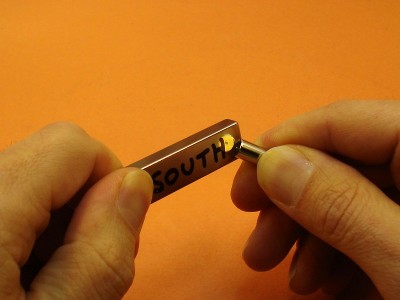
You can find several types of Pole Identifiers available on the K&J Magnetics website.  The simplest to use is the Electronic Pole Finder.  Simply point the tip at one side of the magnet, press the button, and an LED will light to indicate the polarity, North or South.  On a production line, this is your best bet.  It works well, consistently, and avoids any confusion.
A less expensive option is the D4X0-ND magnet.  It has a small dimple on the North end of the cylinder, and can be used to identify the poles on unmarked magnets.  The North pole of one magnet will be attracted to the South pole of another -- just remember that opposites attract!

Compass #1 - Magnets on a String

If you don't have a pole identifier readily available, you can use a little science to find the North pole of your magnets.  Your magnet's North pole is attracted to the Earth's North pole.  Technically, the Earth is labeled backwards -- the geographic North pole is actually like the magnetic South pole of a magnet.
If you hang a small stack of magnets on a long thread, the magnets will freely rotate.  Hang up your 3 foot length of string on a stable platform, like an overhead light.  Once it stops wobbling, the North end should be pointing North.  If you know roughly which direction is North (the sun rises in the East), you'll find your magnet's North pole.

Compass #2 - The Floating Magnet

Water Compass with an axially magnetized cylinder magnet
A fun science project is to float a magnet on piece of Styrofoam.  The lightweight, floating platform gives the magnet a nearly frictionless surface to freely rotate on.  The north pole quickly becomes obvious -- plus it's neat to play with!  This is a great science project idea for kids.

Compass # 3 - A Magnet on Edge

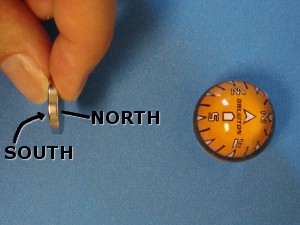
Less interesting to build, but super simple: You can place a disc magnet on it's edge on a smooth surface.  If your magnet is sized right to balance this way, it will twist to point North.  Simple, but effective.

UPDATE #1: Plastic Coated Pole Identifier Magnet

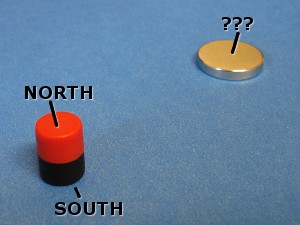
A red and black D68PC-RB magnet near a plain DC2 disc magnet. Which side is the north pole of the unmarked DC2 disc magnet?
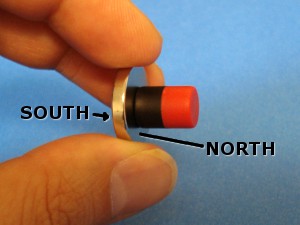
The south pole of the plastic coated magnet touches the north pole of the disc magnet.
The north pole of the plastic coated magnet touches the south pole of the disc magnet.
Our D4X0-ND cylinder magnet with a dimple at the north pole has long been a favorite of ours.  It is a simple tool for identifying the north pole of another neodymium magnet.
We recently introduced the two-color, plastic coated D68PC-RB magnets.  These cylinder magnets are red on the north pole and black on the south.  They've become our new favorite pole-identifying magnet.
The plastic coating makes it more durable, and won't tend to scratch another magnet.  When identifying the pole on larger magnets, this is especially good news.

UPDATE #2: Use a compass to indentify the poles of your magnets

The south pole on the compass points to the north pole of the magnet.
The north pole on the compass points to the south pole of the magnet.
The north arrow on the compass points to the south pole of the magnet.
The south arrow on the compass points to the north pole of the magnet.
What about using a regular compass that you might have on-hand to identify the poles of your magnets?  Remembering which end of the compass points to which pole of the magnet can be confusingy.  It is easy to get mixed up.  As described in our article, The Earth Is a Magnet, the earth is a big magnet with the magnetic south pole actually located in the north (in northern Canada, currently).
The labeled pictures below should be a good guide to using a compass to identify the poles of your magnets.  See the descriptions.  Or, remember that they're pointing in the same direction.
The inexpensive, sphere-shaped compass actually uses a neodymium magnet inside.  The traditional needle compass uses a piece of magnetized steel.  Be careful to avoid getting a neodymium magnet too close to this second type of compass.  The powerful magnetic field of a neodymium magnet could demagnetize the needle, or even magnetize it in the opposite direction!


Neodymium Magnet Information

Magnet Terminology

The terminology of magnetics is not widely understood.  You can find definitions of most terms on our Glossary of Magnet Terminology Page.

Rare Earth

Neodymium magnets are a member of the Rare Earth magnet family and are the most powerful permanent magnets in the world. They are also referred to as NdFeB magnets, or NIB, because they are composed mainly of Neodymium (Nd), Iron (Fe) and Boron (B). They are a relatively new invention and have only recently become affordable for everyday use.

Grades of Neodymium

N35, N38, N42, N38SH...what does it all mean? Neodymium magnets are all graded by the material they are made of. As a very general rule, the higher the grade (the number following the 'N'), the stronger the magnet. The highest grade of neodymium magnet currently available is Grade N52 magnets. Any letter following the grade refers to the temperature rating of the magnet. If there are no letters following the grade, then the magnet is standard temperature neodymium. The temperature ratings are standard (no designation) - M - H - SH - UH - EH.  You find the temperature rating of each grade on our Specifications of Neodymium Magnets Page.

Specifications of Neodymium Magnets

If you need detailed information about the physical and thermal properties of neodymium magnetic materials, you can find it on ourSpecifications of Neodymium Magnets Page.

Platings/Coatings

Neodymium magnets are a composition of mostly Neodymium, Iron and Boron. If left exposed to the elements, the iron in the magnet will rust. To protect the magnet from corrosion and to strengthen the brittle magnet material, it is usually preferable for the magnet to be coated. There are a variety of options for coatings, but nickel is the most common and usually preferred. Our nickel plated magnets are actually triple plated with layers of nickel, copper, and nickel again. This triple coating makes our magnets much more durable than the more common single nickel plated magnets. Some other options for coating are zinc, tin, copper, epoxy, silver and gold. Our gold plated magnets are actually quadruple plated with nickel, copper, nickel and a top coating of gold.

Machining

Neodymium material is brittle and prone to chipping and cracking, so it does not machine well by conventional methods. Machining the magnets will generate heat, which if not carefully controlled, can demagnetize the magnet or even ignite the material which is toxic when burned. It is recommended that magnets not be machined.

Demagnetization

Rare Earth magnets have a high resistance to demagnetization, unlike most other types of magnets. They will not lose their magnetization around other magnets or if dropped. They will however, begin to lose strength if they are heated above their maximum operating temperature, which is 176°F (80°C) for standard N grades.  They will completely lose their magnetization if heated above their Curie temperature, which is 590°F (310°C) for standard N grades. Some of our magnets are of high temperature material, which can withstand higher temperatures without losing strength.

Strength

If you've never handled neodymium magnets before, you will be amazed at their strength. Neodymium magnets are over 10x stronger than the strongest ceramic magnets. If you are currently using ceramic magnets in your project, you could probably use a much smaller neodymium magnet and have greater holding force.   You can get an idea of the relative strength of each of our magnets on our Magnet Summary Page.  The surface field of each of our stock magnets is also listed on that same page.  We also offer an online magnet calculator to help you estimate the pull force and field strength of magnets at any distance from the magnet.
The potential uses for strong neodymium magnets are unlimited!

Thursday, December 24, 2015

New magnetic charger lets you juice up iPhone wirelessly

The STACK PACK takes the cord out of charging your iPhone.
We are wireless, but not quite wire-free. One company wants to help iPhone users cut a couple of cords with a magnetic charging solution called the STACK PACK.
It’s all capital letters for a product that sounds more like workout vitamins. The STACK PACK promises to pack just as much power as that soon-to-be obsolete charging cord — except with shorter charging times and a satisfying feeling as your iPhone magnetically clicks onto a battery or charger.
Charging solutions represent a significant part of the electronics accessories market. Cables, charging stations, external batteries and the like offer faster charging or extra juice on the go, but companies only recently began using magnets to give devices an invisible lifeline.
Another device, called PowerGo-Go and featured by Cult of Mac in October, offered a similar system but failed to meet its crowd-funding goal.
STACK PACK became available for sale Thursday and is ready to relieve the iPhone user’s mind of cord-management woes.

When the battery reads red, a STACK PACK power pack can keep your iPhone online.
For starters, there is no hint of a cord in the startup company’s name, which happens to be STACKED. It starts with a plug-in charging base. A case for your iPhone 6/6s or 6 Plus/6s Plus magnetically secures to the base for charging. The STACKED ecosystem also includes a magnetic battery that attaches to the case when power starts to run dry.
Charge everything at once, including the iPhone and extra battery.